
Exhibition
Portal
October 7, 2015
ICPNA Lima Centro, Lima
In part, her pieces are the strict result of the (let us call it “astral”) conjunction of art and science, while the rest is definitely in the sphere of sorcery (or magic). However, there is another conjunction that stands out: the images are also the result of methods of production that combine both traditional techniques and multi-media processes, including paint, silk-screening, found objects, embroidery, beads, hand-applied glitter, computer aided design, and (as a sort of catalyzing element) exterior lighting in both reflection and refraction, such as the use of light-emitting diode circuits (LEDs).
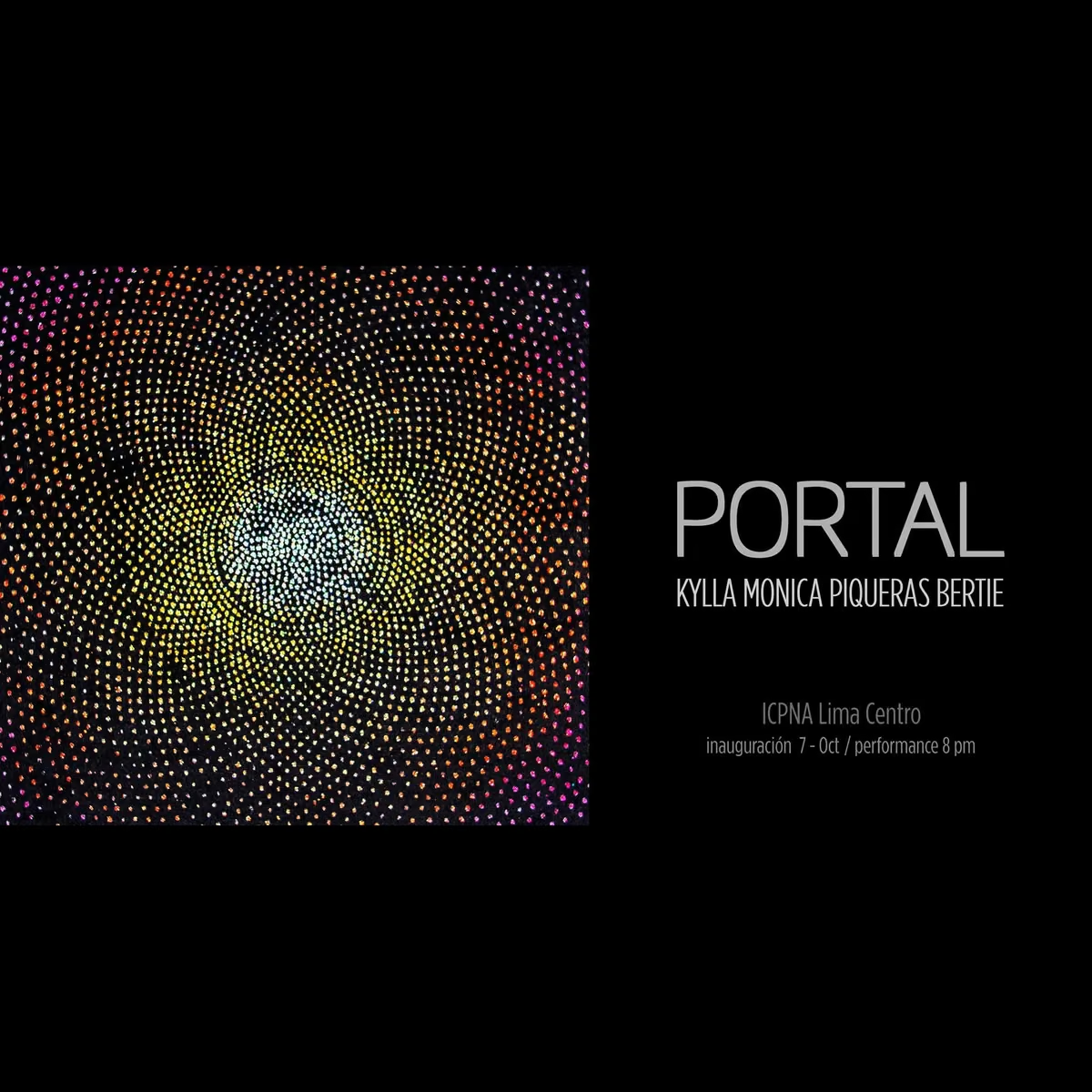
Formally, the process in various pieces depicts a center which is visually magnetic, an astral nucleus of sorts, surrounded by points that unfold spiral arms that, although expanding in various directions, evoke the shape of laconic and geometric mandalas (“circle”, in Sanskrit), recalling that iconic oriental representation of connection between the macrocosmos and microcosmos. In others, successive silk-screened layers of color overlap in symmetrical shapes that cover the surface, similar to the small grids that cover both the veins of certain leaves and the lines of visible tissue that cover the folds, wrinkles or cracks of the skin. In both cases, these references (astronomical, phytomorphic or epithelial) suggest a process of capture, transmission, and irradiation of energies which the artist describes as “a desire to reflect light’s original force in its multiple dimensions”; and this emanation or effect received by the eye is somewhat resistant to photography.
Here, reality is made up of divergent fields that are medularly linked or inserted into one and another, as if they were replicas with variations which, like a personal embroidery, connect the inner and outer spaces, following an unknown pattern or algorithm that permeates the visible and the invisible in the various scales of its fractal structure. Other shapes are created from those described, but spread out like a matrix in a set of mirrors (or kaleidoscope), where a pattern, already present in other pieces, opens and juxtaposes to a mimetic twin, creating other, perhaps unforeseeable shapes and images, between borders and junctions that vibrate animated by a sort of music or dance, with their own unique, autogenous, and in a sense, secret logic, making the frames that circumscribe their images stand out, on the contrary, as a vulnerable contour, which tends to disseminate with its various forms (like the pulsations of a quasar) the forces, magnitudes or rhythms articulated within it.
Understood as embodied frequencies or visions, the artist establishes a connection between these images and several closely related references: on the one hand, the geometric patterns made up of fine layers of sand on a glass or metal plate, which, in the 19th century, the German physicist and musician Ernst Chladni, considered the founder of acoustics (as well as a pioneer in studies on meteorites), made vibrate at different amplitudes and frequencies, creating ephemeral drawings with the sound waves; and, on the other hand, the kené (“design”, in the Shipibo-Konibo language), which are traditionally understood as a musical notation of sorts. If the icaros sung by shamans are the rudimentary way of producing the sound adopted by a certain vibration of energy in each living thing, those resulting graphic forms, which are drawn by the women of this tribe from the Amazon jungle, can be seen as scores for these otherwise imperceptible languages, which attempt to dialogue or connect with the sacred. Just as we know that sight perceives the light that bounces off of objects in different wavelengths, and therefore, that the image of an object is in fact no more than an emanation, the similarity between the shapes drawn on the so-called “Chladni plates” (particularly, between 800 and 6200 Hz) and many of the kené drawings seems to suggest that similar results can be produced through different ways of examining reality. Whether the subject is affected or not by these frequencies (and in what way), is a question that may find paths to clarity within a dialogue which has yet to take place, between the physical and visible principles that are the basis for cymatics and the transcendental and healing experience that is carried out in these guiding chants, as part of ancient practices and rituals in the heart of the Peruvian jungle.
These interstices (gaps or connections) do not seem to point us precisely toward an entity, substance or being (being of little importance whether abstract or concrete), but instead reserves for us temporary lodging in the very residence of between: both the teachers and the ancestors that the artist and the spectator have or have not previously found or perceived, have been summoned here (among them, her paternal great-grandfather, architect and sculptor Manual Piqueras Cotolí), not as paradigms but as acting forces and living iconographies. There lies the religious and at once subversive slant of this community with no precise territory, deliberately assembled in this space: the world as we know it has established its dominion based on a fundamental discrimination that reduced both the place for symbolic or mythical thinking (so-called primitive thinking) and the role of women, and therefore, as suggested by Silvia Federici, the witch hunt is not an insignificant chapter in pre-modern folklore or ignorance, just as the current economic system, consolidated after centuries of colonialism and slavery, is not.
Observable reality has been quantified under only the narrow paradigms allowed by theory, with the devices and fields of investigation-experimentation that it allows. If other worlds, other ways to access the Multiverse await (or exist), beyond those detected by the Large Hadron Collider, is an open question with answers that are still restricted within the modern superstitions that, for some time now, have been called progress or science.
Emilio Tarazona
Bogotá, September 2015